Mathematics portfolio
Minghao Yin
I study mathematics at Tokyo University of Science. I’m interested in how students reason through a problem and what education data can tell us about their learning.
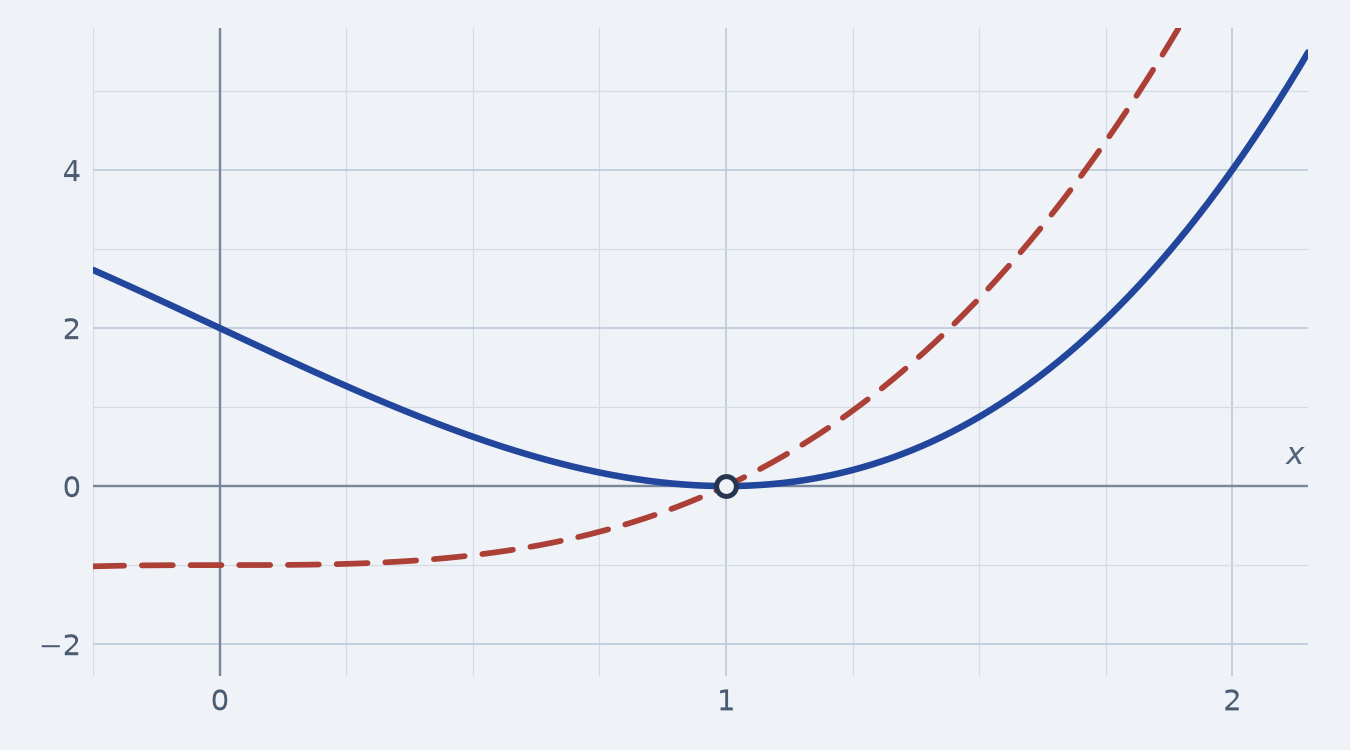
Explore the workTwo curves, one root.
Education data note
Reading Japan’s
PISA results.
How did 15-year-olds in Japan perform relative to the OECD average in 2022? I compare published mean scores in each subject and look at what those comparisons leave open.
Download the data (.csv)Japan and the OECD average
PISA 2022| Subject | Japan | OECD avg. | Gap |
|---|---|---|---|
| Mathematics | 536 | 472 | +64 |
| Reading | 516 | 476 | +40 |
| Science | 547 | 485 | +62 |
The mathematics gap is 64 score points: 536 minus 472. This comparison describes average performance. It cannot tell us which teaching practices produced the difference.
Method, sources & calculation
I used the rounded means published in OECD Economic Surveys: Japan 2024. Each gap subtracts the OECD mean from Japan’s mean in the same subject. The results are estimates from sampled students. These differences do not describe every student or account for variation between schools.
- OECD source table · Basic statistics of Japan
- OECD country note · PISA 2022, Japan
- Download the calculation (.py)
Save the CSV and Python file in the same folder. Run python verify-pisa.py to reproduce the three differences.
Bilingual mathematics notebook
When does a root
count twice?
Both polynomials in the graph vanish at 1. Only one contains two copies of the factor (x − 1). Here is how to find it, with a Japanese model solution and a Chinese explanation of the key step.
The factor theorem
p(x) = x³ − 3x + 2 とおく。p(1) = 0 より、因数定理から p(x) は x − 1 で割り切れる。商を q(x) とすると q(x) = x² + x − 2 であり、q(1) = 0 である。したがって商も x − 1 で割り切れ、1 は p(x) の重根である。
第一次代入 1 得到 0,只能确定有一个因子 x − 1。把它除掉,再检查商。这里的商在 1 处仍等于 0,所以还能再除一次。对照 x³ − 1,第一次除完的商是 x² + x + 1,代入 1 得 3,因此只有一个 x − 1 因子。
Proof idea To look for a second copy of a factor, apply the factor theorem to the quotient.
Academic background
About Minghao.
Mathematics undergraduate
Tokyo University of Science · April 2025–present
I study in the Department of Mathematics, Faculty of Science Division I. My coursework includes analysis, algebra and geometry. Alongside my classes and the university mathematics club, I organise study notes that pair Japanese worked solutions with Chinese explanations.
The examples on this page were prepared with AI assistance for this student portfolio. The education data come from the OECD publications linked above.